
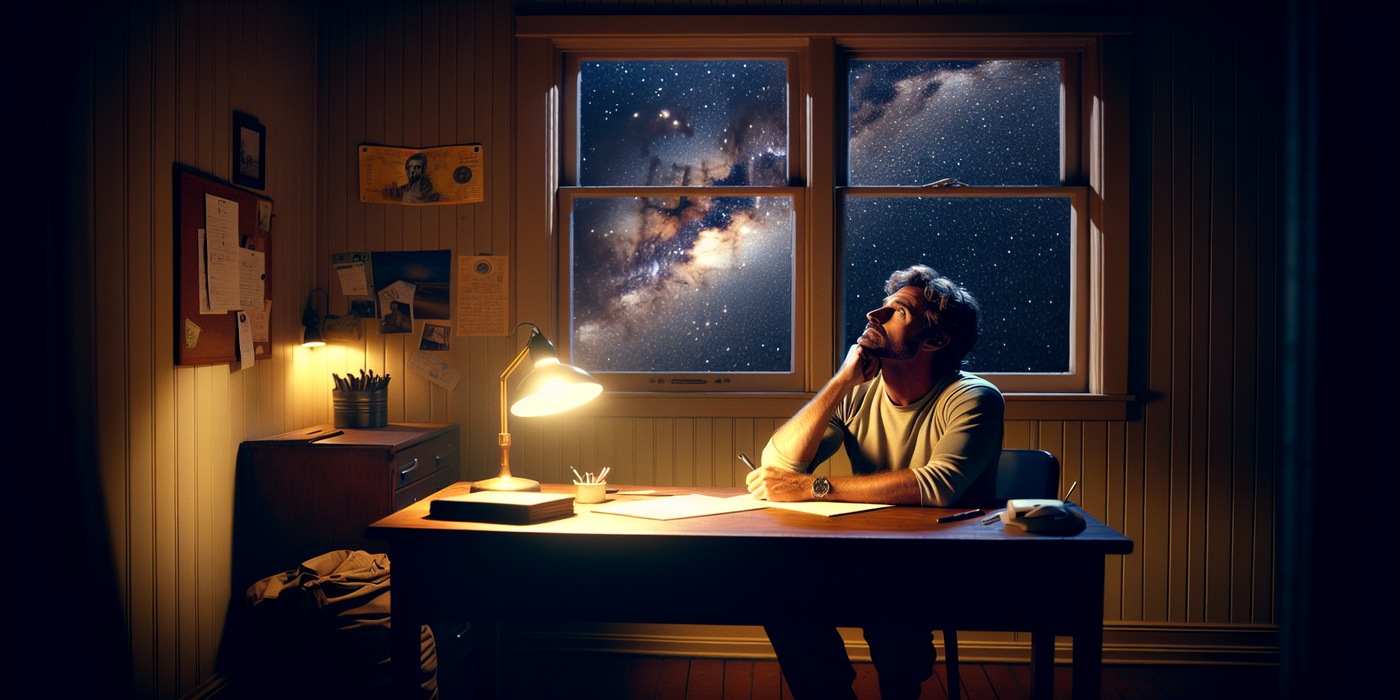
The Question Everyone Thinks But Never Says Out Loud
It’s a fair question. A really fair question.
If God made everything, then who made God? And when did that happen? And who was around before God to do the making?
If you’ve ever thought this and kept quiet because it seemed like the kind of question that would get you a funny look in church, you’re not alone. It’s actually one of the oldest questions in philosophy. Some of the smartest people who ever lived have wrestled with it seriously.
This article is my attempt to work through it honestly, starting with the opening chapter of Genesis and what it actually claims about God, time, and the universe. Some of it will surprise you.
In the beginning.
Not “once upon a time.” Not “long, long ago.” Those words feel like a fairy tale. But “in the beginning” is different. It doesn’t sound like a story. It sounds like a fact. It says: this is where everything started. Everything. Including you and me.
Genesis chapter one is one of the most remarkable things ever written. Not just as a religious text, but as a piece of thinking about the universe. The questions it asks are the same questions scientists are still asking today. The words are ancient, but the ideas are still alive.
God Made Time Itself
Here’s the thing that gets me most about Genesis 1. God doesn’t just make the earth and the sky. God makes time itself.
Think about that.
“In the beginning, God created the heavens and the earth.” The heavens and earth aren’t just things sitting inside time and space. They are time and space. Before them, there was no “before.” There was no yesterday or tomorrow. No sequence of events at all. When God created the universe, he created the very clock that everything runs on.
Here’s the amazing part. Modern science has come to the same conclusion. Scientists say there was a moment before our universe existed called a singularity. A point so dense and so hot that the laws of physics don’t work there. Our best maths breaks down. Our best tools can’t see it. And the reason isn’t that our technology isn’t good enough. It’s that time itself started at the Big Bang. There is no “before” to look into.
So Genesis and modern science agree: everything had a starting point. Nothing can reach behind it.
The difference is that Genesis says someone started it.
And here is where it gets really interesting. If God made time, then God can’t be inside time. You can’t be trapped by the thing you’re creating. A man drowning can’t design the water. To be the one who started time means you exist in a completely different way, a way where time doesn’t hold you.
This is what Christians mean when they talk about God being eternal. Not that God lives forever and ever in a straight line. But that God exists completely outside of time. No beginning. No end. No yesterday or tomorrow. Just an endless present.
A philosopher named Boethius figured this out in the sixth century. He wrote it down while sitting in a prison cell, waiting to be executed. That’s the kind of situation that focuses your thinking. He said God’s eternity is like a single, perfect, permanent now. Everything that has ever happened, or ever will happen, God sees all at once. The way you can look at a photo and see the whole image at once, not bit by bit.
Rabbit Hole: Why Prison Produces the Best Thinking
Boethius wasn’t just anyone. He was one of the most powerful men in Rome. A senator. A consul. He had everything. Then within a year he was in chains, accused of treason, waiting to die. While he waited, he wrote a book called The Consolation of Philosophy. It became one of the most read books in the entire medieval world for a thousand years.
Julian of Norwich was a woman in fourteenth century England who nearly died from illness while the Black Death was killing half of Europe. While she was sick, she had a series of visions. She wrote them down and they became one of the most loved books in the history of Christian writing.
Paul wrote some of his most powerful letters from prison. John wrote the Book of Revelation while exiled on a tiny island.
There’s a pattern here I can’t ignore. It seems like it takes the very real possibility of death to make people think clearly about the things that actually matter. When there’s nothing left to distract you, the big questions finally get a fair hearing.
Which makes me wonder about the rest of us. Comfortable. Busy. Entertained. Are we too distracted to think about the things that matter most?
Think of it like a novelist writing a character. The character lives through time, one day after another, birth to death. But the novelist? The novelist holds the whole story in their head at once. They know the beginning and the end at the same time. God is like that with us, except it’s real, not fiction. And God is the source of our time, not just aware of it.
The Nothing Before Everything
There’s a phrase in Genesis 1:2 that I love: tohu wabohu. It’s Hebrew for “without form and void.” It describes what things were like before God started creating. Formless. Empty. Dark.
Tohu wabohu. Even the sound of it feels empty.
Here’s the remarkable thing. Scientists now describe the very early universe in almost exactly the same way. Right after the Big Bang, the forces of nature, gravity, light, the nuclear forces, hadn’t separated from each other yet. Everything was in one hot, formless, undivided state. No structure. No matter. Just raw energy and heat.
Tohu wabohu.
The person who wrote Genesis had no science degree. No telescope. No laboratory. But the picture they painted matches what our best science now describes.
Then God speaks. Light appears. Things separate. Structure forms. Day from night. Sea from land. Order from chaos. Step by step, the universe takes shape.
Rabbit Hole: Why Chaos Sounds Chaotic
Old languages have a funny habit of using rhyming double words to describe mess and disorder. Tohu wabohu does this in Hebrew. The sound of the words mirrors the emptiness they describe. It’s like the language itself is falling apart trying to describe a world with no order.
English does the same thing. Helter-skelter. Topsy-turvy. Higgledy-piggledy. Willy-nilly. Every one of these is used for disorder and confusion. Nobody knows exactly why humans do this across so many different languages. But it seems like chaos is so fundamental, so deep, that ordinary language can’t quite describe it. So it breaks its own rules.
Tohu wabohu feels older than language. Which makes sense. It was.
I’m not saying Genesis predicted the Big Bang. That’s not quite the right way to put it. What I’m saying is that the person who wrote Genesis had the right instinct: the universe went from nothing and formlessness, to structure and meaning. And that this was intentional. Science describes the same journey. The words are different. But the story rhymes.
God Spoke and It Happened
“And God said, ‘Let there be light,’ and there was light.”
God doesn’t build light out of parts. God doesn’t find light somewhere and switch it on. God says it. And it exists. The word itself is the act of creation.
The Greek word for this is logos. It means word, or reason, or the rational principle behind everything. Later, the Gospel of John would use this exact word: “In the beginning was the Word.” John was saying that the God of Genesis and the logos the Greek philosophers had been searching for were the same thing.
Rabbit Hole: John Steps Into a Very Old Argument
Greek philosophers had been arguing about logos for six hundred years before Jesus was born. Heraclitus used the word to describe the hidden rational order holding the universe together. The Stoics built an entire way of life around it. By the time John wrote his gospel, logos was one of the most famous, most debated words in the ancient world. Every educated person would have recognised it immediately.
So when John wrote “in the beginning was the Word,” he wasn’t just writing a religious opening line. He was stepping into the middle of a six-hundred-year philosophical conversation and saying: that thing you’ve been pointing at all this time, that hidden rational order you can sense but can’t quite name? We know who that is. He has a face. He walked among us.
It’s one of the boldest moves in all of ancient writing. And most people today read right past it without realising what just happened.
Here’s something that’s hard to get your head around. At the very smallest level of matter, the level of quantum physics, particles don’t have fixed properties until they’re observed. Before you look, a particle exists in a kind of blur of possibilities. It only becomes definite when something interacts with it. Reality at its deepest level seems to need a relationship with something outside itself in order to become real.
And matter itself? It’s not solid stuff. It’s mostly empty space held together by energy. The reason your hand feels solid when you touch a table isn’t because things are touching. It’s because the energy fields around atoms are pushing each other away. At the deepest level, matter isn’t stuff. It’s pattern. Relationship. Information.
A universe made of information. Spoken into being by a Word.
I find that hard to shake.
What God Sees When He Looks at You
This is the part that matters most to me personally.
If God exists outside of time, then God doesn’t remember your past. And God doesn’t wait to see your future. God sees your entire life, from the moment you were born to the moment you die, all at once. Like a photograph of your whole life, every moment visible at the same time.
Let that sit for a moment.
Every embarrassing thing you’ve ever done. Every moment you’re proud of. Every time you were kind when nobody was watching. Every time you weren’t. Every version of you, at every age, all present at the same time in God’s awareness.
A theologian named Paul Tillich called this “the eternal now.” A mystic named Julian of Norwich, who lived through one of the worst plagues in history, said it this way: “All shall be well, and all shall be well, and all manner of thing shall be well.” People think that’s just optimism. But Julian wasn’t guessing about the future. She was describing something she believed God had shown her. A reality where the end of the story is already present with the beginning. Where everything, seen from the outside of time, makes sense.
That’s either incredibly comforting or a bit scary, depending on what you’ve been up to lately. Maybe both. That’s probably the right response.
Rabbit Hole: Does Free Will Actually Exist?
Here’s a question that will tie your brain in a knot. If God can see your whole life all at once, including every decision you’ll ever make, does that mean your choices aren’t actually free? If God already sees what you’re going to choose, was it ever really a choice?
This has been argued about for two thousand years. Nobody has come up with a completely clean answer, and I want to be honest about that.
The most common response is this: knowing what someone will choose is not the same as making them choose it. A historian knows what happened in World War Two. That doesn’t mean the historian caused it. God seeing your choices doesn’t mean God is making your choices. They’re still yours.
That answer mostly works for me. But I’ll admit there’s still something uncomfortable left over. If God sees the whole film, was it always going to end the way it ends? Augustine wrestled with this. Thomas Aquinas wrestled with it. John Calvin pulled one way. Jacobus Arminius pulled the other. Very clever people are still arguing about it today.
What I’ve landed on is this: maybe the problem is that we can’t actually imagine what it’s like to exist outside of time. We keep trying to picture God watching events unfold one after another, because that’s all we know. But if that’s not how God experiences reality, then maybe the question itself is built on a wrong picture. The limitation might be in our imagination, not in the answer.
I hold that loosely. But it helps.
Who Made God?
There’s a question that comes up a lot when people talk about God creating the universe. “Okay, but who made God?”
It sounds like a solid argument. Everything has a cause, right? So what caused God?
The philosopher Aristotle thought hard about this nearly 2,500 years ago. Everything that moves is moved by something else, he said. Every cause has a cause before it. But you can’t have an endless chain of causes going back forever, because then nothing ever actually explains anything. You just keep pushing the mystery backwards. So at some point there must be something that starts the chain, something that isn’t itself caused by anything. He called it the Unmoved Mover.
Thomas Aquinas connected this to the God of Genesis and noticed something important. The “who made God?” question assumes that everything must have a cause. But that assumption only makes sense inside time, where everything has a before. If God made time, then God is not inside time. God is not subject to the rule that says “everything needs a before.” Asking what came before God is like asking what’s north of the North Pole. The question doesn’t work. The category doesn’t apply.
This is not a trick or a dodge. It’s just what follows logically if you take Genesis 1 seriously. If God made time, then God is not another thing in the chain of causes. God is the reason there is a chain at all.
A God Who Actually Cares
The thing that strikes me most, once you follow all this logic, isn’t how big God is. It’s how personal.
The God who made time and space and matter is also, according to Genesis, a God who walks in the garden in the cool of the evening. Who calls out names. Who asks “where are you?” Not because he doesn’t know. But because he wants you to answer.
There are more stars in the observable universe than there are grains of sand on every beach on Earth. The universe is roughly ninety three billion light years across. It has been expanding for nearly fourteen billion years.
And yet, Genesis says the God behind all of that is the same God who knows exactly what you’re carrying around inside you today.
That’s not a contradiction. It’s actually the only thing that makes sense if God truly has no limits. A God limited by size could only focus on big things or small things, not both. A God with no limits can hold a galaxy and a single frightened human being in the same moment of attention. That’s what “infinite” actually means.
What I Make of All This
“In the beginning, God created the heavens and the earth.”
The more I look at this sentence, the bigger it gets.
Genesis 1 gives us a way of understanding reality that puts meaning at the centre, not just machinery. A universe with a Creator is a universe that exists for a reason. A universe that started implies a universe that is going somewhere. A God who stands outside of time is a God who can say, with genuine certainty rather than just hope, that it ends well.
I don’t have all of this figured out. I don’t trust anyone who claims they do. But I’ve found that taking Genesis 1 seriously, really seriously, opens up better questions than ignoring it would.
We live in the middle of the story. We can’t see its shape from here. We get one moment at a time, each one disappearing before we’ve fully understood it.
But we can know something about the one who sees the whole thing.
The mind that made a universe capable of producing galaxies and grief, mathematics and music, photosynthesis and poetry. That mind has been thinking about us far longer than we have been thinking about anything at all. And from that place outside of time, where every moment of your life is fully present and fully seen, you are known. Completely. By the one who made knowing possible.
That is what Genesis 1 is actually about.
Not rocks and days. Not a construction project.
The claim that the ground of all being knows your name.
That is either the most important thing you will ever hear, or it isn’t. I don’t think there’s a comfortable middle ground.
One More Thing
If God sees everything, then if we’re honest, most of us know there are parts of our lives we wouldn’t want too closely examined. That gap between who we are and who we sense we were made to be is something most people feel, even if they spend a lot of energy avoiding the thought.
The Christian claim is that this gap has been dealt with. Not ignored. Not papered over. Actually dealt with, at real cost. Jesus of Nazareth, who Christians understand to be God entering his own creation in human form, lived the life none of us have managed, and took on the full weight of everything that stands between us and the God who sees it all. The cross is not a sad ending. It is the point at which the debt was paid.
That is either the most important thing you will ever hear, or it means nothing to you right now. Both responses are worth sitting with. But if this article has made the existence of God feel more real, more worth thinking about, then the honest next question is a personal one.
If he’s real, and he sees everything, and there’s a way back: what are you doing about it?
Further Reading
The Science
- The Big Bang, NASA Science — NASA’s plain-English guide to how the universe began.
- Big Bang Theory, NASA WMAP — A bit more detail for those who want to go deeper.
The Philosophy
- Aristotle’s Unmoved Mover, Stanford Encyclopedia of Philosophy — The full academic explanation of Aristotle’s argument.
- Thomas Aquinas, Stanford Encyclopedia of Philosophy — How Aquinas connected Greek philosophy to the God of Genesis.
The Primary Sources
- The Consolation of Philosophy, Boethius — Written in a prison cell. One of the most remarkable books ever produced. Free to read online.
- Revelations of Divine Love, Julian of Norwich — Julian’s visions, free online. Start anywhere.
The Scriptures
- Bible Gateway — Every Bible translation, free and searchable.
“Where were you when I laid the foundation of the earth? Tell me, if you have understanding.” Job 38:4
“Before I formed you in the womb I knew you.” Jeremiah 1:5
“For God so loved the world that he gave his one and only Son, that whoever believes in him shall not perish but have eternal life.” John 3:16
“In him we live and move and have our being.” Acts 17:28
